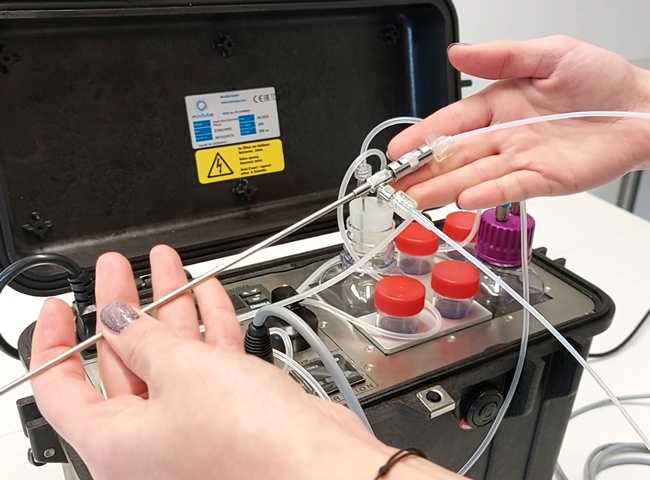

Equine OPU at the highest level
How Minitube pump and needle technology makes the difference
Recent scientific work by the research group led by Juan Cuervo-Arango has advanced our understanding of how to optimize oocyte recovery during ovum pick-up (OPU) in mares. These studies examined the role of technical equipment and demonstrated that pump and needle design, particularly Minitube systems, play a key role in improving process control, efficiency, and oocyte quality.The Minitube pump: Precision, temperature control, and workflow efficiency
While the studies showed that oocyte recovery rate (ORR) is largely unaffected by aspiration pressure alone, oocyte quality is strongly influenced by aspiration parameters. High aspiration pressures were associated with an increased number of denuded oocytes and resulted in reduced maturation and blastocyst rates. Similarly, high injection pressures during follicular flushing led to lower ORR and increased loss of oocytes through leaked flushing medium.The Minitube pump addresses these challenges by providing precise control of both aspiration and injection pressures. This allows clinicians to work with low, well-controlled flow rates, helping to prevent follicular overfilling, minimize oocyte loss, and preserve the developmental potential of recovered oocytes.
Another important feature is the temperature-controlled compartment for collection and injection bottles. As oocytes should not be exposed to temperatures below 22°C to avoid cellular damage, this is especially useful for OPU procedures in cooler clinical environments.
In addition, the combined aspiration and injection control enables single-operator OPU procedures. Unlike manual syringe-based injections, which typically require a second operator, the Minitube pump improves workflow efficiency, reduces labor requirements, and supports greater procedural standardization.
The Minitube needle: Superior visibility and cost-effective reusability
Needle selection has also been shown to impact OPU outcomes. Reusable, double-lumen Minitube needles with an echogenic tip outperformed single-use needles lacking echogenicity in terms of ORR. In particular, follicles smaller than 10 mm could not be reliably punctured using non-echogenic needles, reducing oocyte recovery.The echogenic tip provides excellent ultrasound visibility, enabling accurate puncture of both small and large follicles. Although reusable needles require an initial higher investment, they can be safely reused up to ten times, resulting in a comparable cost per OPU session to disposable alternatives while delivering greater reliability and consistency.
Conclusion: Making a difference in Equine OPU with Minitube pump and needles
The work of Cuervo-Arango and colleagues demonstrates that successful equine OPU is defined not only by recovery rates, but by the quality and developmental competence of recovered oocytes. By combining precise pressure control, integrated temperature protection, optimized workflow, and enhanced follicle visibility, the Minitube pump and needle system offers a comprehensive solution for standardizing and optimizing OPU procedures.For practitioners aiming to improve consistency, efficiency, and biological outcomes, Minitube technology provides a scientifically validated advantage at every step of the OPU process.
Literature:
- Factors influencing oocyte recovery during ultrasound-guided follicle aspiration in mares: A postmortem study
Adri´an M´arquez-Moya , Laura Sala-Ayala , Nerea Carreras-Vico , Rebeca Martínez-Boví , Juan Cuervo-Arango - The Influence of Aspiration Pressure, Follicle Flushing Method and Needle Rotation During Single-Operator OPU Technique on Oocyte Recovery and Embryo Production in the Mare
Juan Cuervo-Arango * , Laura Sala-Ayala , Adrián Márquez-Moya and Rebeca Martínez-Boví - Transvaginal Follicle Aspiration in Mares: A Description of Different Techniques and Comparison of Results Across Different OPU Clinics
Juan Cuervo-Arango1 | Denis Necchi2 | Amber Clutton-Brock3 | Magdalena Profaska4,5 | James Crabtree6 | Anthony Claes7 - Use of excised ovaries for oocyte recovery by ultrasound guided follicular aspiration – Validation of an experimental model for research purposes in live mares ovum pick up
Laura Sala-Ayala a, Aleksandra T. Pytel b,c, Karolina Stychno c, Juan Cuervo-Arango